
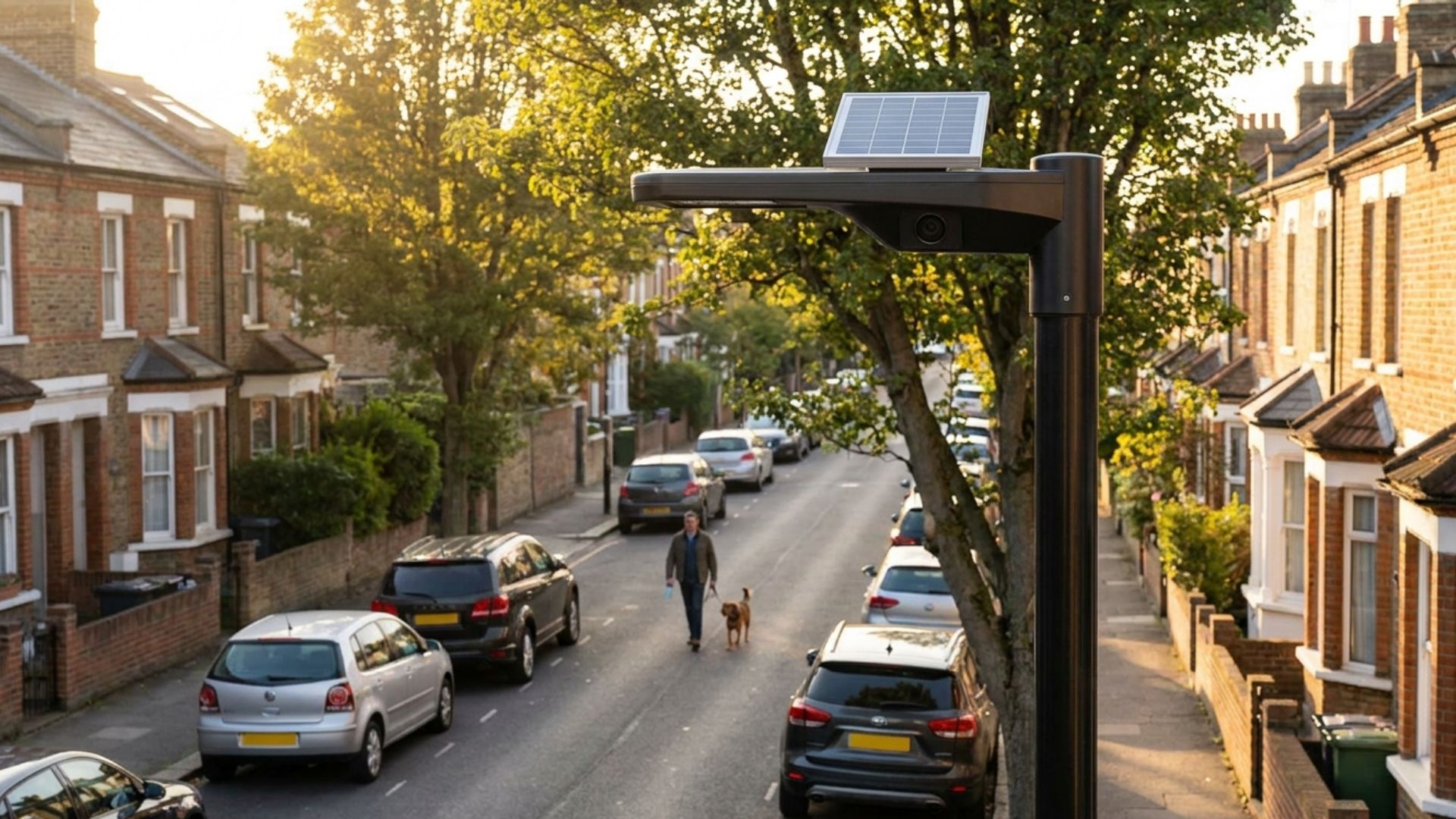
A new generation of camera-equipped “smart” lamp-posts is beginning to appear in the UK, bringing new questions about how AI-enabled public infrastructure should be governed. Designed with the potential to incorporate capabilities such as facial recognition, gait analysis, and behavioral detection, these systems illustrate how quickly traditional public infrastructure can evolve into something far more sophisticated.
A recent Guardian piece examines the arrival of these “smart” streetlights in Britain, focusing on a product called the iLamp from Warwickshire-based Conflow Power Group. The article raises questions that anyone deploying AI-powered security technology needs to take seriously: who controls the data these systems collect, how transparent are the organizations deploying them, and what happens when capabilities are added quietly over time without public awareness or consent?
These are not abstract concerns. They are exactly the right questions to be asking.
The infrastructure problem
One of the most important observations in the Guardian piece comes from Jasleen Chaggar of Big Brother Watch, who notes that much of today’s surveillance infrastructure is built with the capacity to add functions later. A camera installed for one purpose can, with a software update, become something with meaningfully different capabilities overnight.
This creates a governance problem that compounds over time. When the people responsible for deploying a system do not fully understand what it can do, and the communities living within its range were never consulted, the foundation of trust that any long-term deployment requires simply does not exist.
The piece also raises a critical data ownership question, illustrated by a case from the Netherlands in which a local authority discovered that data generated by a waste collection optimization program belonged to the vendor, not the council. Poorly constructed contracts and unclear data ownership left the authority with no recourse. The example illustrates a broader question that also applies to physical security deployments: when data passes through third-party infrastructure, organizations need to understand exactly who controls it, where it resides, and what contractual rights govern its use.
Capability and trust are not the same thing
The Guardian article captures an important tension in the public conversation around surveillance technology: acceptance of cameras in public spaces does not necessarily translate into informed understanding or consent for every capability that may be layered onto them. The difference is not the presence of the camera. It is what the system does with what it sees, how accurate it is, who has access to that output, and whether the person captured in the footage has any say in the matter.
This distinction matters enormously for organizations deploying AI video security. The strongest case for these systems is not that they watch everything. It is that they make the people responsible for security more effective, with tools that are accurate, transparent, and structurally limited to the purpose they were deployed for. Systems that overclaim, generate false positives, or expand their scope without clear governance undermine the case for AI in security broadly, not just for their own deployments.
How Koshee approaches this
The concerns raised in the Guardian piece reflect real risks of a particular approach to deploying AI video intelligence: one where data leaves the organization’s control, capabilities expand without transparency, and the people using the system do not fully understand what it is doing.
Koshee is built around a different model.
Koshee Protect runs on-premises, within the organization’s network and behind its firewall. Video intelligence is processed locally rather than relying on third-party cloud processing, helping organizations maintain control over sensitive video data and the environment in which the system operates. The system is designed to give security teams real-time awareness and structured, actionable intelligence while keeping humans firmly in control of what happens next.
The public conversation around smart surveillance infrastructure is accelerating. The organizations that will build lasting trust are the ones that take data ownership, transparency, and governance seriously from the start rather than retrofitting those considerations after deployment.
That is not a constraint on what AI video security can do. It is the foundation that makes it work over the long term.
Read the full Guardian article: Spies in the Sky: How Worried Should We Be About the Arrival of AI-Enabled Smart Lamp-Posts?
Learn how Koshee delivers AI video intelligence with on-premises processing and local data control: Contact Us